Come in. The little keeper minds the door, but the book past the door is yours — one file, opened in your own browser, kept on your own device. Nothing in it phones home, nothing counts your streaks, and nothing will ever tell you that you did a spell wrong or read a card badly. The Mirror keeps what you write and quietly notices what returns. That is the whole law of the place, and it is worth saying plainly before the tour begins: It shows. It never grades.
THE FIRST NIGHT
Here is the book’s first night, exactly as it happens — real footage of the real file, no cuts, no dressing up. You will see the opening questions about how your craft leans and what counts as a result, then the wheel of eight rooms, then a first working written and remembered: quiet sleep for the house, a sprig of lavender, saved under that night’s true moon. Ninety-one seconds, and silent on purpose.
THE WHEEL OF THE BOOK
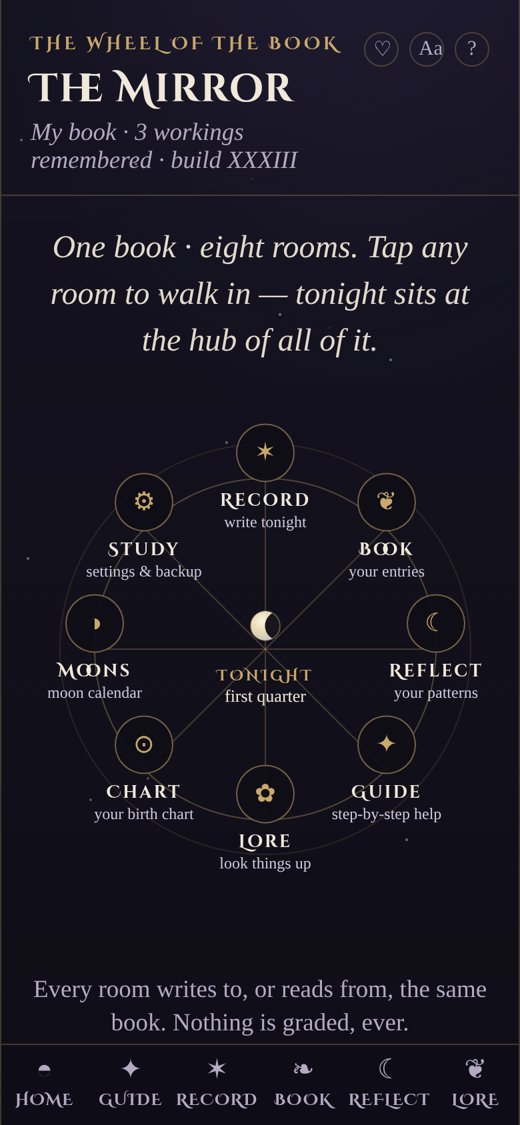
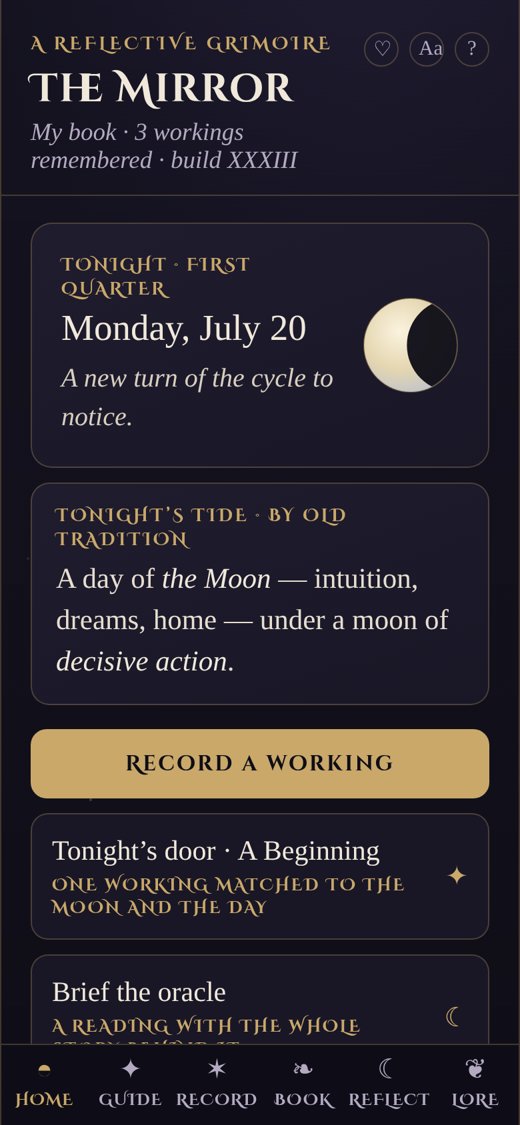
When the questions are done, the book opens onto the wheel. Eight rooms stand around one hub, and the hub is always tonight — its moon, its tide, its door. Every room writes to the same book or reads from it; nothing you do in one room is hidden from another, and nothing anywhere keeps score. Walk the wheel clockwise from the top and it goes like this.
RECORD
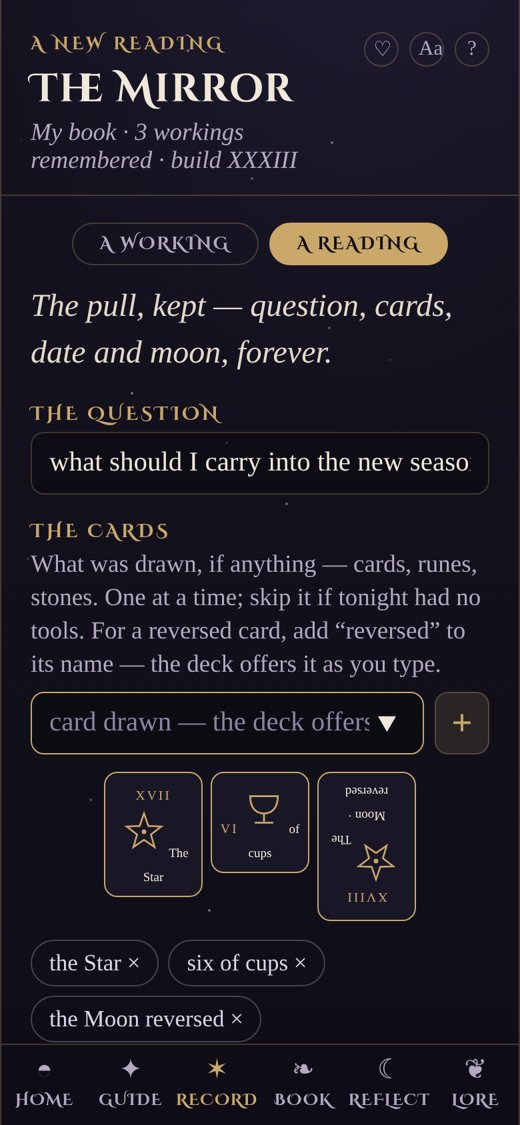
Record is where tonight gets written down. A working — a spell, a charm, a rite, whichever word you chose on the first night — takes an intent, a kind, and the materials you actually used, nothing more. A reading takes the question and the cards as they lay on the table; start typing a card’s name and the deck offers it, reversed cards and all. Either way, the date and the true moon are kept with the page without your asking.
BOOK
Book is the shelf. Every entry you have ever written lives here, newest at the top, each one under the moon it was made beneath. You can seal a page to a future night — a letter your later self opens when that date comes round, and not before. And you can keep a separate book for a friend, so their readings stay in their own covers and never mix with yours.
REFLECT
Reflect is the quiet room. It reads back through your own past pages — only yours, never anything borrowed from elsewhere — and shows what returns: the card that keeps finding you, the moon you always write under, the intent that comes back each season. Ask it a question and it answers from your own entries, in your own words. While the book is young, Reflect says little. It would rather be brief than invent.
GUIDE
Guide is the hand on your shoulder. Choose what is stirring — protection, rest, letting go — and it walks you through, one step on the screen at a time, at your own pace. The Field Guide inside it is written for first nights and for scared friends, plain enough to hand to someone who is shaking. And the Steady Hand waits one tap from anywhere: the screen drops to candlelight and the grounding steps come slowly, even with no signal at all.
LORE
Lore is the reference shelf. The herbs and what they are traditionally kept for, the cards and their faces, and a glossary of the words the craft uses — so when a page somewhere says besom or sachet, you need not leave the book to ask. Nothing in Lore tells you what to believe. It only tells you what the words have meant, and leaves the believing to you.
CHART
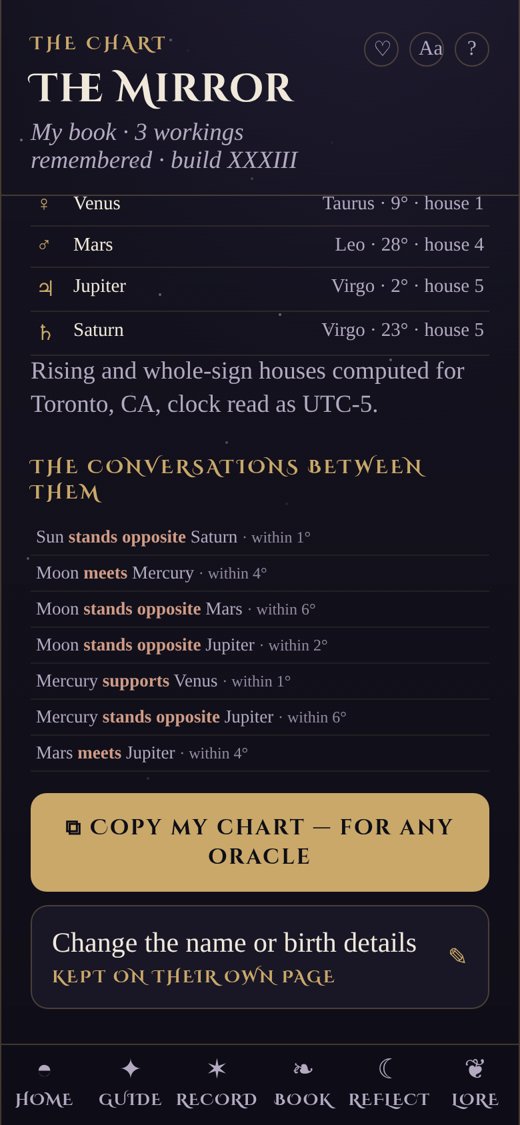
Chart is the sky on the night of birth, drawn whole and then said in plain words: the rising sign, the ten placements, and the whole-sign houses each one sits in. It is computed in the book itself, on your device, from the date, time and place you give it.
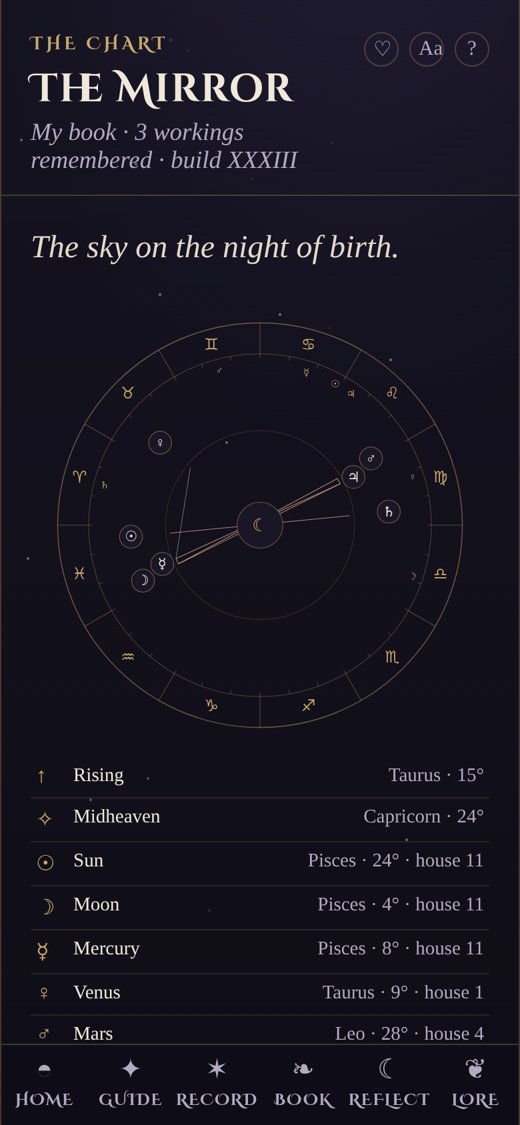
Below the wheel, the conversations between the planets are named the way you would say them aloud — stands opposite, flows with, meets — never as numbers to pass or fail. And one gold button copies the whole chart as plain text, ready to carry to any oracle you trust.
MOONS
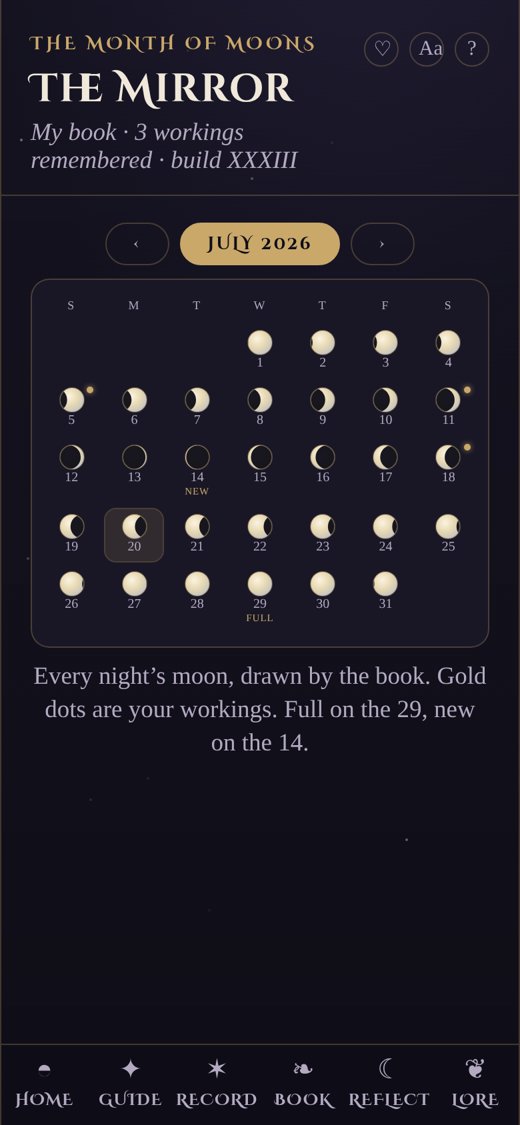
Moons is the calendar. Every night of the month appears with its true moon drawn as it will actually hang in the sky, the new and the full marked by name, and a small gold dot on any night you wrote something. Page back far enough and the dots become a shape — the shape of your own practice, month after month, visible at a glance.
STUDY
Study is the back room where the practical things live. Your name and the book’s name, the reading pace, and — most important of all — backup: export the whole book as a single file you can keep anywhere, and import it again on a new device or in a new browser, whole and unharmed. It is the one room that is about the book rather than in it.
KEEP IT YOURS
The book has one rule of keeping: it lives where you open it. Your browser holds it, on your device — so return in the same browser, at the same address, and it will always be there waiting, exactly as you left it.
On an iPhone, the book is simply the address. Visit it once in Safari, then choose Add to Home Screen, and it becomes an icon among your apps — and after that first visit it works with no signal at all, on a plane, in a basement, at the edge of a field.
And give it one small ritual. On each new moon, open Study and export a backup — one file, kept wherever you keep precious things. Do that, and no lost phone, no cleared cache, no spilled tea can ever take the book from you.